Monday, January 25, 2010

"Mary's Waltz" Now Available for Purchase!


These past couple of weeks have been unusually busy (what with the moving to a new apartment, visiting the ol' homestead, starting second semester of schoolin', adopting the sweetest pit bull in the world, and auditioning for Glee).

This is just a quick note to let you know that Volume 2, Issue 1 of Collective Fallout, featuring my story "Mary's Waltz", is now available for purchase! You can pick up a copy here for $9 + shipping (digital copies also available).

For those of you who are skeptical about spending money on something you may not fully enjoy, the good folks at Collective Fallout have thoughtfully provided excerpts of all the stories on their website (there is poetry too, but that is kind of difficult to excerpt -- "I have eaten the plums." READ THE FULL POEM NEXT ISSUE!). When my own copy arrives, I intend to post reviews of the individual pieces here as well.

In the meantime, below is the blurb I wrote for the coverletter for "Mary's Waltz", should you require further enticement:

"When Grace meets her new neighbor Mary, an enigmatic young blind girl, Grace is immediately drawn to her by a physical curiosity too new to name. But as the friendship blossoms, so does the nightmare, as Mary's secrets - and intentions - slowly creep out of her. MARY'S WALTZ is a speculative fiction piece that contains elements of horror and magical realism. It explores themes of sexual awakening, sacrifice, and love as destruction, while representing homosexuality as a non-issue."

Thursday, January 14, 2010

Weak Stories and How to Spot Them, Part 2


(Continued from previous post.)


9. The "far-out" uncle or grandmother who is really just a vessel for the author's own political bias/racism/sexism/religious fervor. I like to say that I am all of my characters and I am none of my characters, but with this pet-peeve we have a clearly overstepped boundary line that is usually quite glaring. I'm sure there are many examples, but the only one I can think of right now is from the book Wit's End which I recently read for class. The godmother is preoccupied with liberal-leaning politics that just scream, "This is what I, Karen Joy Fowler, really think about the American government!" And when said author came to speak to the class, she totes admitted this. Alls I am saying is, try to let your ideas come out in the story, not through some preachy character.

10. Skinny bitches. Praise different body types, people! Especially if your story is set within a culture whose ideals of attractiveness are different from your own. Pay attention. It's called Realism. (....maybe?)

11. Heroic males. It's just played out.

12. Books without chapters. Now, I know this is a small structural thing, but I really admire chapter breaks. The point of them is to break up what you're reading and give you a chance to breathe, in the same vein of a period or paragraph break. They can also serve to break up the time-line of your story, or switch perspectives. Longer stories can certainly work without chapter breaks, but for me, it's a detriment to ignore them.

13. Overuse of internal monologue. "At the circus, I couldn't stop looking at Brian. Was he looking at me when I wasn't looking at him? Did he want me to look at him? Should I go over and say hi? If I went over and said hi the worst thing he could do is ignore me, I suppose. Or, well, the worst thing he could do would be to spit in my face and call me a cow and pants me before taking a picture as I cry and then run away and elope with my mom. But I don't think that would happen. Would it?" Versus, "I ran into Brian at the circus and I couldn't stop looking at him. Finally, I decided to say hello."

14. Single paragraphs that span entire pages. Again, it's a breathing issue. I open a book to a page and it's covered in text, I get overwhelmed and turned off from any desire I had of reading it. White space on the page is psychological oxygen for the reader; don't choke it all out!

15. Demonstrative dialect. "Didja wa' 'im ta put ou' da ca' now, Missa Rod'rick?" Just distracting.

16. Lack of quotation marks to denote speech. Lack of paragraph breaks or dialogue tags could also be added here. I'm not saying there isn't a way to make this work, but I haven't seen it yet. I (and many others) grew up learning to read a certain way, and so rather than being a stylistic choice or a narrative choice or whathaveyou, doing away with quotation marks is just messing with the signifiers I've been conditioned to look for. It gets frustrating.

17. Assholes we're supposed to like. Especially if also the female lead who hates the douche eventually ends up with him. I'm looking at you, every romance novel ever (not to mention innumerable crime novels as well).

18. Rhetorical questions. This is pretty much in tandem with overuse of internal monologue. Jodi Picoult, this means you.


Thus concludes that jumble of words and punctuation marks. I'm visiting my hometown next week, and school starts up again (finally!) the week after that, so my return to this blog may be even more sporadic than it already has been. But when I do return, we'll delve into what I think make strong novels, and maybe I'll list a few of my favorite novels so you know how many grains of salt to use when measuring my judgments.

Tuesday, January 5, 2010

Weak Stories and How to Spot Them, Part 1


Recently, I picked up a copy of No Plot? No Problem!, a rather neat little bundle of encouragement directed toward those brave souls who take on the National Novel Writing Month challenge of writing a 50,000 word novel in each November. (Otherwise known as NaNoWriMo.) I didn't participate this past year because I was concentrating on short stories rather than longer works, plus building my Freeze Ray. The book is great for pumping you up to dive headfirst into a ridiculously long draft of something you may never look at again, but it feels pretty wonderful to churn out so much work in such a short time. If you find you are slow when drafting work (i.e. does it take you a year to write twenty-five pages? congratulations, you are me!) then NaNoWriMo is a great exercise for you to try.

The book comes with a few quick exercises to help you suss out this whole writing thing. One exercise I enjoyed was to list all of the things you think make good stories and all of the things you think make bad ones. Of course, I'd like to try to be a smidgen more objective by using the terms "weak" and "strong" instead of "good" and "bad," no matter how fruitless it may be to try to keep personal opinions objective. So here is my list:

18 Things that Make Weak Stories

1. Too much "romance". (I don't know why that word is wrapped in quotations in my notebook.) Look, I know love makes the world go 'round and all that, but throwing in a worn out love story subplot can really sap attention away from your main point and just drag the whole thing down into a sugar-sweet mess of "I am going to save this world...but only cuz you're in it and I got a thing for you something awful, baby." There are a million reasons people do the things they do, and boiling it all down to "love" is oversimplifying it.

2. Boring characters. Ummmm....how to avoid boring characters? I would say give them unique quirks, but I do believe that is noted somewhere later on this list as being a no-no. I suppose Cliched Characters could substitute here. I want to read about raw, gritty, emotionally fragile, unpredictably damaged people, not archetypes.

3. Cliched or unrealistic dialogue. Especially when someone is obviously trying to write hip language. Remember Dawson's Creek? Kevin Williamson may have intended to write kids who are intelligent and not talk down to his audience, but he sacrificed authenticity for these aims. Let's see if I can think of someone who really knows how to write dialogue...let's think....hmmm...who could it be...could it be .... Satan? I mean, uh, Joss Whedon, oh yes, that guy again. Also Tine Fey did a good job with Mean Girls. I point out movies and television as examples because it's all about how you hear the dialogue, and thinking in this way allows me to better avoid the pitfalls of cliche. Word.

4. Too many characters. It's awesome you have all these wonderful people with whom you want to populate the landscape of your story, but be careful how many you throw at me and how fast. I want to remember more than their names, and I want each of them to have a meaningful presence in the story.

5. Unimaginative names. Some of the worst character names in contemporary genre fiction: Sookie Stackhouse; Bella Swan; any hard-boiled detectives named Jack, John, or Jake. This doesn't mean you should go out and name your character Dickie Moorcock, but come on, get creative! I must admit, though, that I do overstep my bounds with this one on occasion; I have a character named Placenta Vagina Female Smith. He's a real great guy.

6. Dense setting description. This can be a tough balancing act, but all I really need is a sense of temporal and spatial place and we're good to go. Unless the setting has some bearing on the psychological make-up or behavior of a character, or is written in a particularly beautiful way, it just does not need to go on longer than a few paragraphs (and sometimes that can be too much).

7. Lack of figurative language. I find this most annoying in young adult novels. They spell everything out for you. I understand reading comprehension grows in stages, but come on - let the teens work a few things out for themselves. YA is not the only fiction that does this (and not all YA does this), mind you. But there's something called subtlety that is sorely lacking in many of today's most popular titles.

8. Forcibly quirky characters. When you have to stick the nosy neighbor lady with twelve cats and a penchant for wandering outside in her knickers in there, for cheap laughs or to buff up your word count, it's just...it's just time to reconsider. Now if she knows the secret formula for the viral infection that's spreading rampant through the city and the only way to protect this knowledge from the evil Martians is by harboring said twelve cats and performing odd knickers-only rituals by moonlight, then okay, leave it in. But don't do it just to do it.

Check back later in the week (or next week) for Part 2

Saturday, December 26, 2009

2009 Wrap Up

At the end of the year, many publications and individuals enjoy making Top Ten lists to encompass everything they enjoyed this entire year. As I have a terrible memory (a sore liability were I in any other field other than the "make stuff up!" industry), I can't remember ten whole things I did this year, yet alone ten movies I saw or CDs I downloaded or games I played. So here are my Top One lists for 2009:

Top One Movie
1. Whip It!  - Everyone expects Ellen Page to be Juno for the rest of her life, which is unfortunate. Juno would never join a Roller Derby league, you guys. But you know who would? All of the fine ladies in this smile-ear-to-ear little gem sweater of a movie.

Top One Book
1. Dark Places  - Gillian Flynn is a relatively new voice in the suspense/thriller genre, one I welcome with open arms. She has some trouble with endings (bringing everything together too fast/too conveniently), but the journey she takes you on is always uniquely enthralling.

Top One Comic
1. Runaways - It didn't come out this year, but I discovered it for myself this year so it counts. I devoured this thing. Someone make the first arc into a movie, please. I will buy you donuts. Please?


Top One Music
1. Sainthood - Tegan and Sara. More synths, more pop, more delightful. Doesn't quite match the emotional landscape of The Con, but it still finds heavy rotation in my iTunes list.

Top One Video Game
1. Rock Band 2 - I know it isn't a new game, but it is still the best way to waste an afternoon. Tip: don't play after ten pm, for the sake of your neighbors.


That's it!  If I think of any more Top Ones, I'll edit this entry to reflect that. Perhaps movie reviews will return next year, but I make no promises. See you in 2010!

Monday, December 21, 2009

"Mary's Waltz" to be Published in January Issue of Collective Fallout


Sorry I have been away from the blog for longer than usual. I've been really busy with choir.

Remember when I ranted out some superfluous advice as an unpublished writer last entry? Well, those days are over, my friends. Now I can dish out disposable wisdom as A Writer Who Has Officially Been Published At Least One Time! I am having medallions made up with that very inscription. T-shirts available next week.

Here is a Long Tale About a the Journey of a Story from Concept to Publication


Well, first, here is a BRIEF SUMMARY OF EVENTS. Collective Fallout is a relatively new literary magazine focusing on publishing sci-fi/horror/fantasy- and queer-themed fiction (the content must fall under this umbrella, not necessarily the author). They publish two issues of their print journal every year, and the first issue of next year (January) will include a story of mine entitled "Mary's Waltz" (the story I have alluded to in previous entries). This is my first publication outside of my undergrad lit mag, and I am really excited about it! You can read an excerpt of my story here, and check out some of the other works as well!

If you're interested, here is how "Mary's Waltz" came to be (warning: if you don't want to be bored by disorganized thoughts on the writing process, go here instead):

Last year a friend of mine introduced me to PARSEC, an annual sci-fi/horror short story contest. What drew me to this contest was the fact that there was no entry fee, and even if you are not selected as a winner (I think there is a cash prize, but money should never factor into why you write or you will very quickly become a bitter, bitter person) you receive a brief written critique of your work with your rejection letter. A free critique without the awkward and intimidating immediacy of a workshop? Amazing. I couldn't pass that up. There is also a different theme or motif each year that must play an integral part in your story. In '09 this theme was Black Glass.


My friend told me about the contest about a week before the story was due. I banged out a very rough draft of what is now "Mary's Waltz" and what was then "The Girl, The Scorpion" in about three hours, proof-read it once, and sent it out the next day, knowing full well it was not going to win. But writing for a solid block of three hours felt exhilarating after not writing for so long; writing a new short story after spending over a year on my undergrad novel felt even better. (Short story writing and novel writing are completely different crafts, but I'm sure I'll dive into that in more detail at a later entry.)


With "The Girl, The Scorpion," I took an existing idea and tried to fit it into the theme, or the theme into it. My favorite band Over the Rhine has a song called "Mary's Waltz," about a blind girl who sneaks out of her house at night to dance. This image captured me. A couple of years ago, I was exploring various dorm buildings with a friend of mine on Antioch's campus, and we came upon a door with an incredible amount of locks on it. What purpose, these locks? People always ask where storytellers get their ideas, well here it is: What if? That is what we start with. For me it was, "What if there is something behind a door that desperately wants you to come in? What if this something is sinister? What if you struggle and toil and finally open the door and before you can celebrate......" Wait, what am I going to put behind the door? That was less of a concern than Who will I get to open the door? Why will this person be able to open it and what will it mean for them? Would it mean something else to someone else? So these were the questions that propelled me to begin, and then of course I plopped some lesbians in there because that's what I do, and I made Mary blind because of the song, and her blindness in the rough draft had absolutely no significance but I found it later. The door also had very little significance (one of the story's many problems, as pointed out in my generous one-paragraph critique), and there was no connection between it and either of my main characters. (P.S. This is why guidelines for short story submissions - as well as your creative writing teachers - will always implore you NOT to send a first draft. They are very wise.)


But where was the Black Glass? The Black Glass was the door handle, but it was also the scorpions. Man, the scorpions was the best idea I never had. It comes from the nonfiction memoir Don't Tell Mom I Work on the Rigs by Paul Carter. For recreation during one of his oil rig tours in some jungle, Carter watches the natives construct a cage small enough for this scorpion so that it will lose a fight to the death with a mouse. (Also interesting note about scorpions, if you put them in a pan and set a fire under it, they will puncture themselves with their own stingers to avoid burning to death.) So this insane image of mouse besting scorpion stayed with me and all I had to do was wait for the best place in a story to use it. (Incidentally, it was also the one thing about my first revision of this story that my workshop class considered too unbelievable.)

So where do storytellers get their ideas? They ask themselves What If, and then they steal other people's life experiences. Done and done.

Anyway, I of course got my rejection letter which included a helpful critique that influenced some of the changes I made in my first revision of the piece. I turned this revision over to my workshop group at SF State and fourteen separate minds helped me fine-tune the thing. I revised one more time and then I sent it out. Really, it is a fluke. I was indexing places to send stories to use at a later date (thinking to revise "Mary's Waltz" at least one more time) when I found Collective Fallout and realized their deadline was in like a week. So I thought, what the hell? And here we are. (For the record, I still think the story could benefit from a stronger ending [the one thing that has been retooled the most], but there tends to be a fine line between tinkering just enough and tinkering too damn much. Gotta move on.)

Gosh, I really love the writing process; how much a single story transforms from your mind to the page to the reader's mind. Fascinating.

So what have we learned, kids?

A) Writers steal all of their ideas
B) Real life is stranger than fiction
C) You should send your shit out cuz someone else will want to read it

Please do not literally send out your feces. But if it simply can't be helped, here is the address of my high school bully:

Billy Henderson
1236 Westfield Drive
Springfield, IN 56340

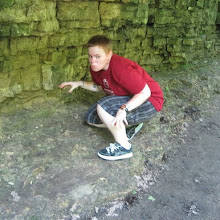
The left image is the photo of him I used to project the image on the right, which is probably what he looks like now.


Sunday, December 6, 2009

Unsolicited Advice from an Unpublished Lady

Tip #1:

Do not write about vampires. (Or werewolves.) This theme is dead; it may be popular among the kiddies right now, and you may want a piece of that over-baked pie, but seriously, honey, if you ain't got nothing new to add to the goth make-up of your alluringly pale protagonists, just put down the keyboard and back away slowly.

This isn't (only) my personal bias talking. Recently I have been researching horror and speculative fiction literary magazines (through the wonderful resource of duotrope, thank you for asking), and nine out of ten sites make mention of vampires somewhere in their submission guidelines, in the form of DO. NOT. WANT. But they say it much more literarily.


Seriously, people, there are so many other, fresher, less trampled metaphors to be plumbed out there. Mmmm plums. For instance, my story is about a blind girl who sees through the eyes of spiders due to some unspecified magical thingy, who then steals the tongue of another girl in order to stop seeing with said spider eyes (by way of magic, again). It's a metaphor for abusive relationships!

It's true that your idea does not have to be an original one (we're running out of those...maybe?), but the spin you put on it, the style with which you write it, the voice in which you tell it, the characters you move through it - those things have to be unique in order to get noticed. My philosophy is, write what you want to read. I haven't seen many stories about sense-swapping teenage lesbians and magical doors to magictown in mainstream fiction (I haven't seen many teenage lesbians in mainstream fiction, period), so I decided to write my own. (You wake up in the middle of the night with a craving for creepy blind girls, what else are you gonna do but write it yourself. ...What? We all have needs.)

EXEMPTIONS

1. Joss Whedon. Look, my unhealthy obsession with Buffy the Vampire Slayer not withstanding....oh, who am I kidding, that particular obsession influences everything. Joss Whedon tinkered with vampire mythology and managed to make it broodingly enticing (yes, a little cheeseball too, but like a fine brie, no empty calories). He can do whatever he wants.

2. Fan-fiction. You can write whatever the crap you want on fan fiction boards. Someone will invariably like it, and then ask you to read their slash, and you'll be all "what is sla--ohdeargodwhyareEdwardandAngelDOINGTHAT!!?!" But it's cool. (Angel is the top in this scenerio, obvs.)